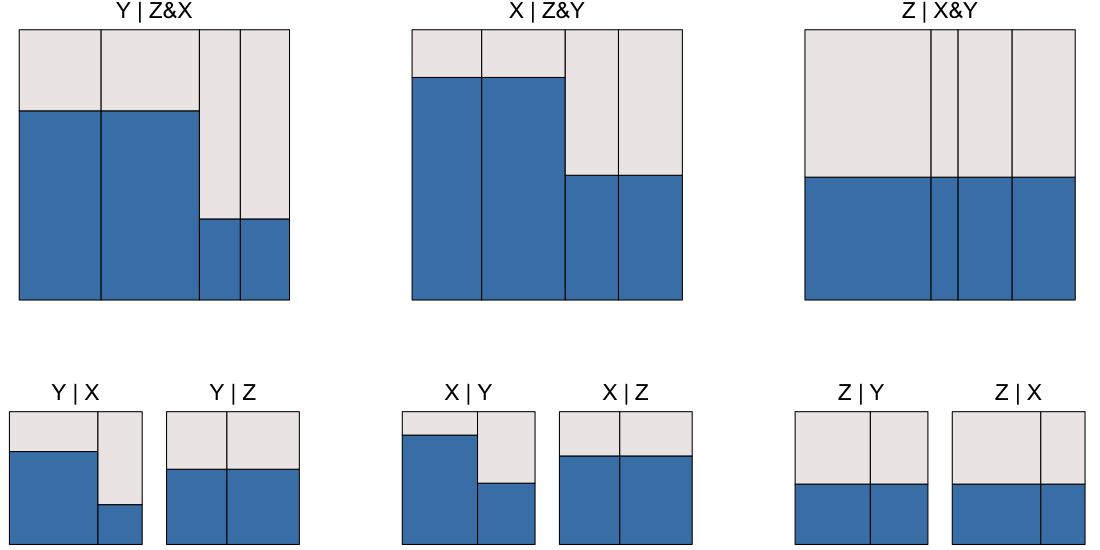
Tuberculosis 1910 death rates in New York and in Richmond
Source:R/tuberculosis_1910.R
tuberculosis_1910.RdTuberculosis 1910 death rates in New York and in Richmond
Format
A 2 x 2 x 2 table of counts involving three binary variables
- Group
One of two racial groups: "White" or "Colored"
- City
One of two U.S. cities: "New York" or "Richmond"
- Total
Either total deaths from tuberculosis or total population in 1910: "Deaths" or "Population"
Source
"An Introduction to Logic and Scientific Method" by Morris R. Cohen and Ernest Nagel, (1934), Harcourt, Brace and Company, New York.
Details
These are historical data taken from page 449 of Cohen and Nagel's 1934 "Introduction to Logic and Scientific Method". For this reason, the original names of the racial groups have been retained.
The data are of special historical interest in Statistics because they are one of the earliest recorded instances of a real Simpson's paradox (Simpson 1951) occurring in practice (see Blyth 1971). Preserving this historical context, the questions posed by Cohen and Nagel (1934) are also recorded here using their own words. The data and questions appear at the back of their book as exercises on "Chapter XVI: Statistical Methods".
In their table, Cohen and Nagel (1934, p. 449) include the "death rates from tuberculosis in Richmond, Virginia, and in New York City in 1910". These rates (in number per 100,000) are easily calculated and so have been excluded from the table given here.
In their words, Cohen and Nagel (1934, p. 449) pose the following two questions as exercise (*emphasis* is theirs):
"a. Does it follow that tuberculosis caused a greater mortality in Richmond than in New York?
b. Notice that the death rate for whites and that for Negroes were *lower* in Richmond than in New York, although the *total* death rate was *higher*. Are the two populations compared really *comparable*, that is, homogeneous?"
References
Blyth, Colin R. 1972. On Simpson's Paradox and the Sure-Thing Principle. Journal of the American Statistical Association, 67, pp.364-366.
Cohen, Morris R.; Nagel, Ernest. 1934. An Introduction to Logic and Scientific Method. Harcourt, Brace and Company. New York.
Simpson, E.H. 1951. The Interpretation of Interaction in Contingency Tables. Journal of the Royal Statistical Society, Series B, 13, pp. 238-241.